Overview
Lovebirds are nine small African parrot species, of which three — peach-faced, Fischer's, and masked — dominate the pet trade. They are living proof that parrot character does not scale with size: bold, busy, affectionate, and occasionally tyrannical, all in a 6-inch frame. Their fame rests on the intensity of the pair bond, but the honest picture is broader: this is a clever, long-lived little parrot that thrives on companionship of any species — including yours.
Temperament & personality
A hand-raised lovebird is a pocket companion: affectionate, playful, and endlessly busy shredding paper, riding in pockets, and supervising the household. The feistiness is real, though — lovebirds, especially hens in breeding condition, can be cage-territorial and nip with conviction, and a pair bonded to each other may have limited interest in people. Socialisation from a young age makes the difference between a charming companion and a tiny dictator.
Appearance
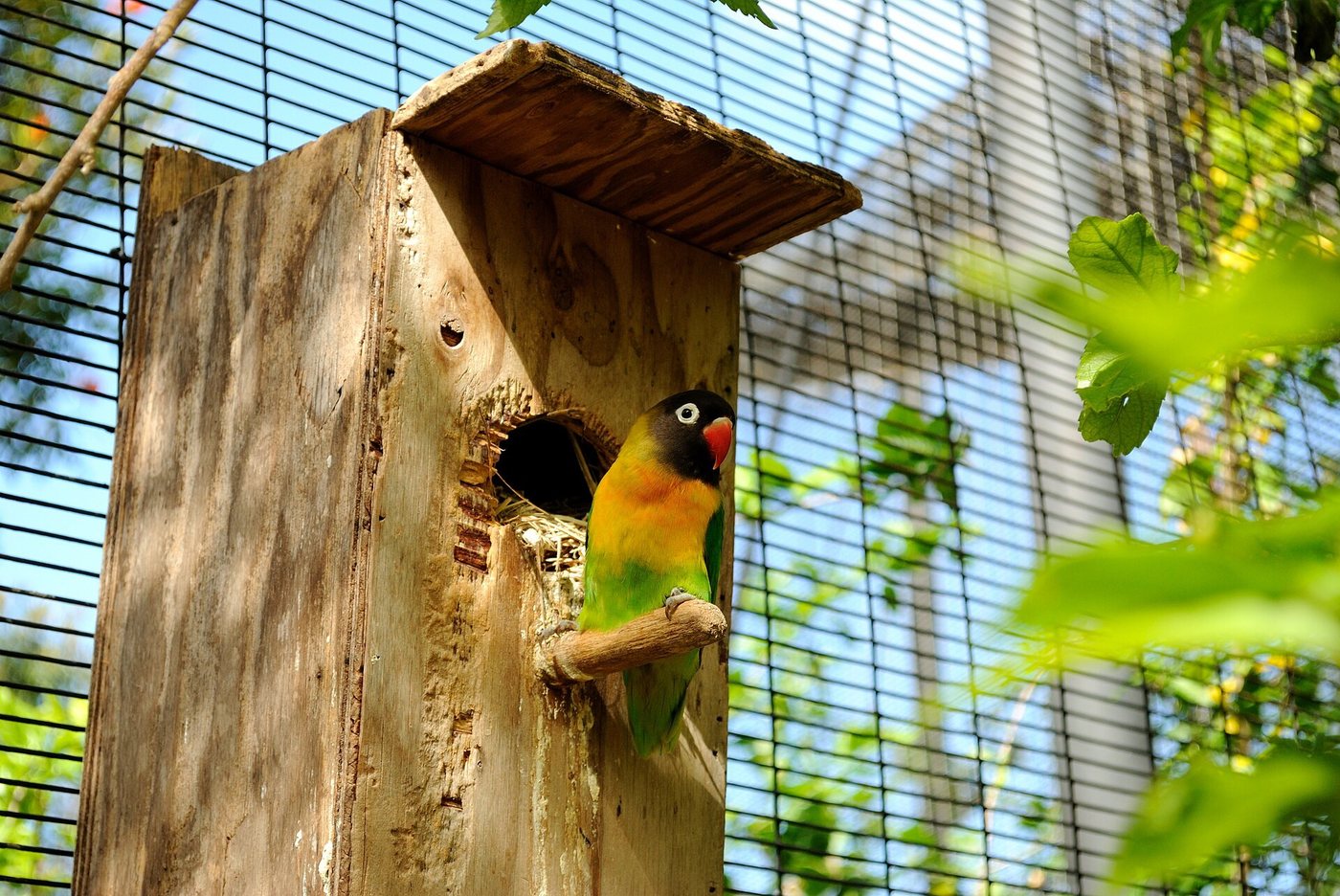
Tiny, compact parrots with short wedge-shaped tails and large beaks for their size. The familiar peach-faced lovebird has a green body and rose-pink face; Fischer's has an orange face and white eye-ring, and masked lovebirds wear a dark hood. Colour mutations — lutino, blue, pied — abound in the peach-faced. Despite the folklore, the nine lovebird species vary; the pet trade rests mainly on these three.
Care & daily life
Lovebirds need a cage wider than it is tall (about 24 × 18 × 24 inches minimum for a pair, bar spacing ½ inch), flight time out of the cage, and shredding toys they can carry and tuck — paper-stripping is a signature lovebird behaviour. Feed pellets or a quality seed mix with vegetables and leafy greens. Handle young birds daily to keep them tame; a bonded pair will largely prefer each other. Hens can become fiercely territorial around the cage and any perceived nest site, especially in breeding condition.
Health & lifespan
The Lovebird is generally known for the following health watch-points:
- Psittacine beak and feather disease (PBFD) — lovebirds are known carriers and can spread it to other parrots
- Egg binding and chronic egg-laying in hens
- Psittacosis and respiratory infections
- Obesity in sedentary birds on all-seed diets
- Self-mutilation and feather-damaging behaviour in some individuals, notably in certain species and crosses
- Injuries inflicted by cage-mates — pair compatibility is not guaranteed
Living with a Lovebird
Lovebirds suit keepers who want a small parrot with big-parrot attitude and can offer daily interaction for 10–20 years — either as a devoted single companion bird (with the human as flock) or as a bonded pair kept for their own society. They fit smaller homes but not quiet ones; the chatter is high-pitched and persistent. Territorial hens and PBFD screening are the two homework items before purchase.
History
Lovebirds (genus Agapornis, Greek for 'love bird') are native to Africa and Madagascar. The peach-faced lovebird of arid southwestern Africa, the Fischer's of Tanzania, and the masked lovebird are the pet-trade mainstays, bred in captivity for well over a century. Their scientific name and their fame both rest on the pair bond: bonded birds sit in contact, preen each other, and pine visibly when separated — behaviour that made them symbols of devotion in many cultures.