Overview
Barbs have a public-relations problem — one famous fin-nipper (the tiger barb) brands the whole family as delinquents — and the cherry barb is the living rebuttal. A small, soft-spoken shoaler from Sri Lanka's forest streams, it bothers nobody, eats delicately, and saves its drama for courtship, when a settled male deepens through rust and ember to an unmistakeable cherry red. It is a fish for planted tanks and patient keepers: shy at first, increasingly bold as cover and company accumulate, and one of the most satisfying 'before and after' transformations in small-fish keeping.
Temperament & personality
Timid, civil, and quietly social. Cherry barbs hold loose stations among plants, spar gently fin-to-fin over perches, and pick at surfaces for microfauna. The hierarchy is a matter of posture, not violence. They spook at shadows and nets for their first weeks and then settle into a steady, undemonstrative confidence — the fish equivalent of a shy guest who, by the third visit, has a favourite chair.
Appearance
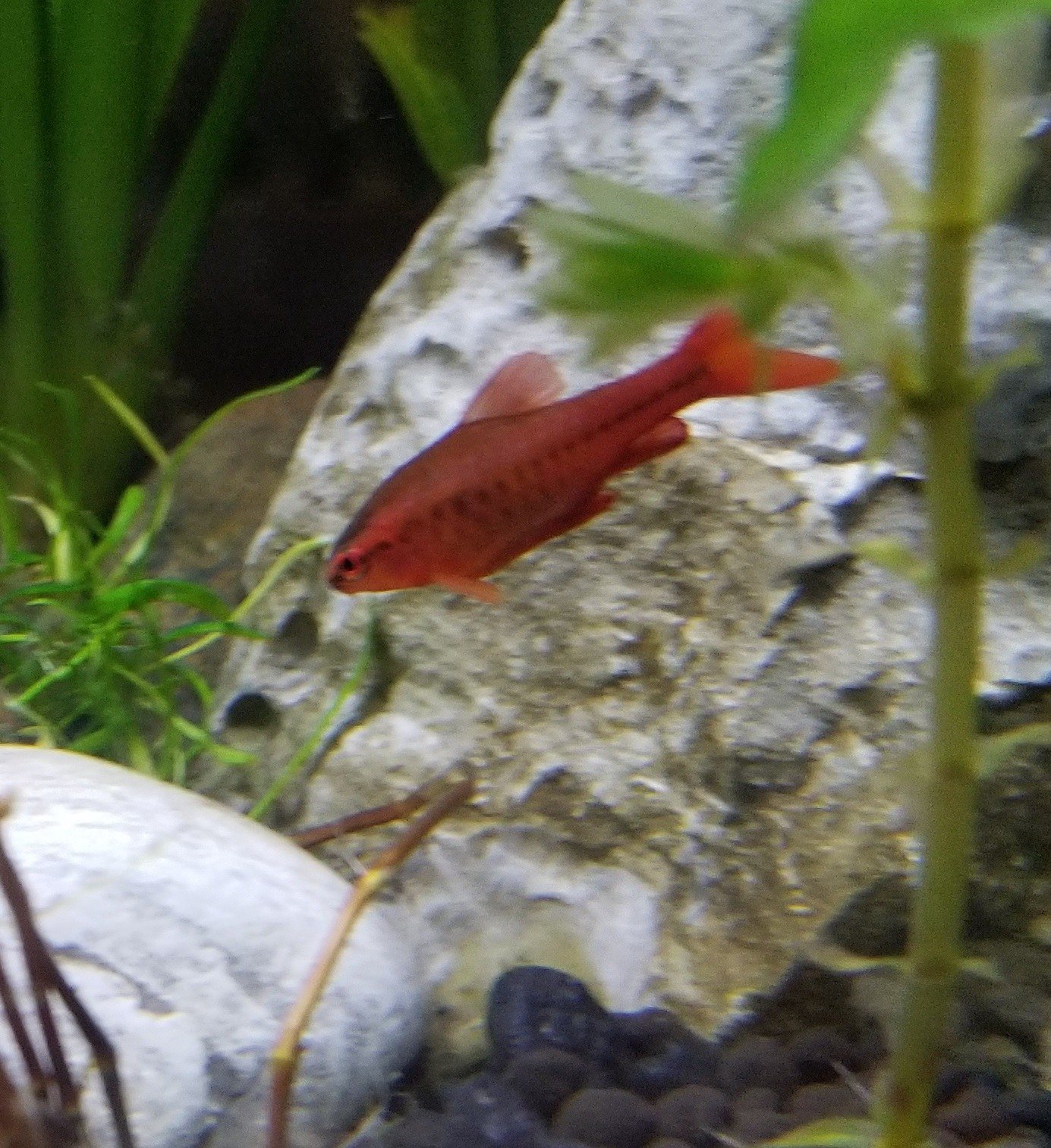
A small, deep-bodied barb of warm copper-brown, with a dark band along the flank and fins edged in black and white that flare dramatically when a male displays. The 'cherry' is aspirational for most fish most of the time — but a male in breeding condition, in soft water over dark substrate, deepens to a saturated scarlet that owns the name entirely. Females stay honey-coloured and rounder; albino and long-finned variants exist but the plain wild-type colour play, male flashing red among green plants, is the fish people actually want.
Care & daily life
Keep six or more (males colour and behave properly only in a group) in a planted 20-gallon tank: soft to medium water at 73–81°F, subdued lighting, dark substrate, floating plants for shade. The school needs plant thickets to retire into — cherry barbs are the retiring kind, and open bare tanks make them wash out and hide. Feed fine foods: micro-pellets, crushed flake, daphnia, baby brine shrimp, and grated vegetables occasionally. They breed readily by scattering eggs in fine plants; most eggs and fry get eaten in a community, though a few survive dense cover. Tankmates: anything peaceful near their size; their own timidity, not others' aggression, is the management problem.
Health & lifespan
The Cherry Barb is generally known for the following health watch-points:
- Ich and velvet in stressed new arrivals — wild-caught and farmed fish both ship stressed
- Shyness-linked wasting in bare tanks (a husbandry failure presenting as illness)
- Columnaris in poor water
- Inbreeding softness in some mass-bred colour strains
- Egg-binding in conditioned females without spawning opportunities (uncommon, but real)
Living with a Cherry Barb
Cherry barbs suit planted community tanks, aquascapes where a scarlet accent is wanted at small scale, and quiet setups with other shy fishes — small rasboras, ember tetras, pygmy corys — that rowdier fish would steamroll. They are a poor answer for bare quarantine-looking tanks, big boisterous communities where they'd never reach the food, or keepers who want immediate colour: the red is earned, by the fish and by you.
History
Cherry barbs inhabit the shaded forest streams of southwestern Sri Lanka, in the Kelani and Nilwala river basins — clear, soft, leaf-stained water under closed canopy, which their tank tastes faithfully reproduce. Wild populations have been pressured by habitat change and collection, and the species is conservation-listed; the aquarium trade today runs almost entirely on captive-bred fish from Asia and Florida. In the hobby's memory it has always been the contrarian barb — imported for generations precisely because it refuses to behave like one.