Overview
Koi are not fish you keep so much as a landscape you inherit: three-foot carp in painted patterns, gliding through a thousand gallons, tame enough to feed by hand and long-lived enough to be written into wills. Japan's breeders turned a food fish into living jewellery over two centuries, and the modern koi pond — filtered like a swimming pool, watched like a garden — is the freshwater hobby at its most ambitious. Nothing about the fish itself is difficult; everything about its scale is.
Temperament & personality
Koi are the gentlest giants of the fish world: social in loose herds, bold at feeding time, and quick to learn the footsteps and silhouette of the person with the food bucket. Individuals develop reputations — the greedy leader, the shy metallic, the one that hand-feeds first. Their calm is their charm: a koi pond's whole aesthetic is slow, patterned movement, and the fish oblige for decades on end.
Appearance
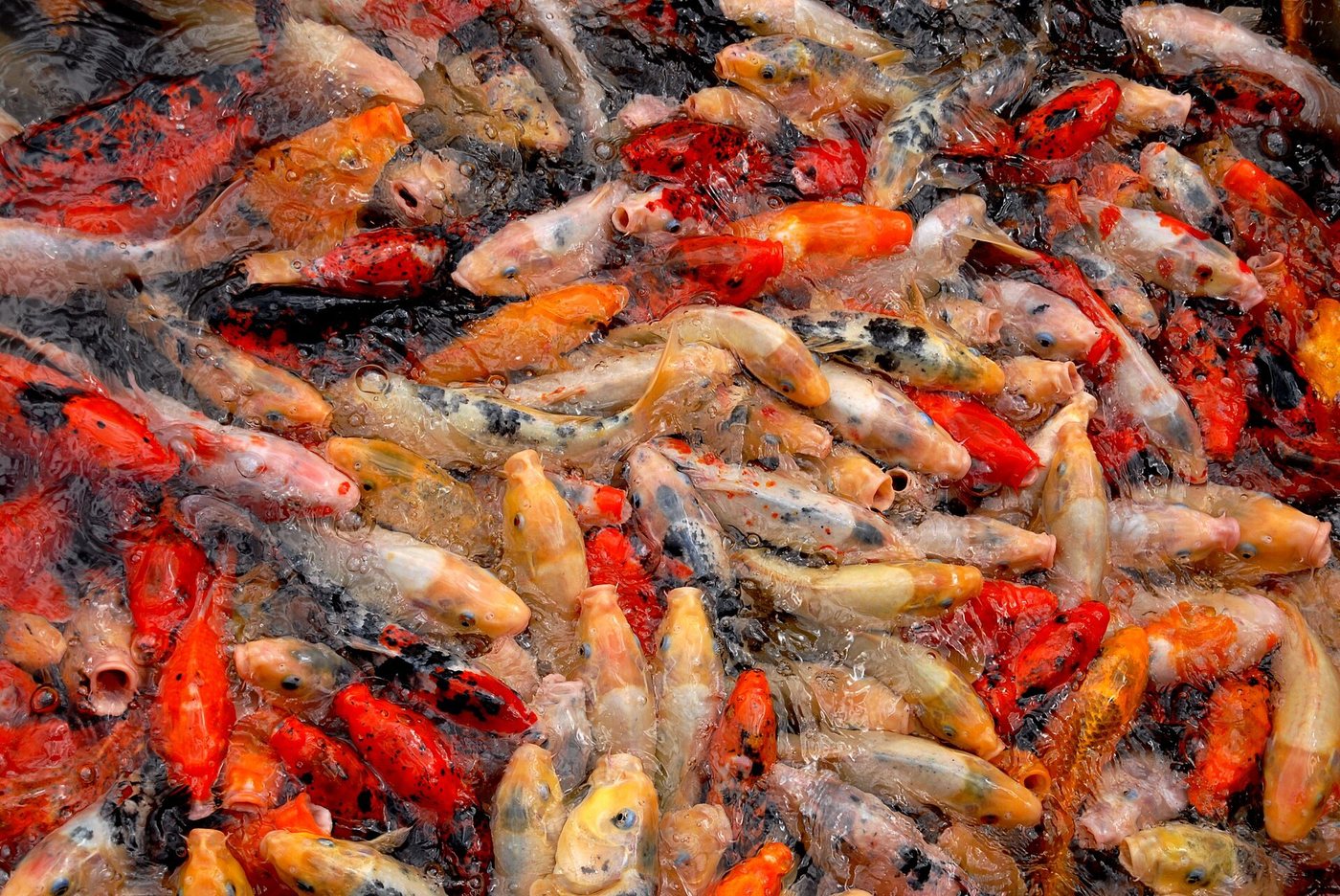
Koi are living paintings: broad, torpedo-shaped carp wearing patterns that breeders name like textile designs — kohaku (red on white, the classic), sanke (red and black on white), showa (black-based with red and white), metallic ogon like hammered gold, and the scaleless or butterfly-finned longfin forms. A quality pattern balances across the whole fish, the colour (especially the red, beni) runs deep and even, and the skin itself has a lustre you learn to see. Sizes are substantial: a koi is not a big goldfish but a genuinely large animal.
Care & daily life
Koi care is pond engineering: a thousand gallons or more, depth of 3 feet or deeper (for temperature stability and predator safety), serious biological filtration plus mechanical solids removal, a UV clarifier if you want gin-clear water, and aeration day and night. Feed floating koi pellets sized to the fish, switching to wheat-germ formulas as water cools below about 55°F, and stop feeding below ~50°F when digestion effectively pauses. Seasonal rhythms rule the hobby — spring health checks, summer growth, autumn fattening, winter quiet under an ice hole kept open for gas exchange. Predator defence (netting, straight deep sides, hiding caves) is unglamorous and essential: herons consider your pond a restaurant.
Health & lifespan
The Koi is generally known for the following health watch-points:
- Koi herpesvirus (KHV) — a serious, often fatal disease of koi worldwide; buy from reputable dealers and quarantine new fish
- Spring viremia of carp and other viral/bacterial outbreaks in warming spring water
- Ulcers and bacterial infections (Aeromonas) following injury, parasites, or poor water
- Parasites — flukes, anchor worm, fish lice, costia — especially in spring
- Winter stress and oxygen crashes under sealed ice without a maintained hole or aerator
Living with a Koi
Koi suit pond owners — which is to say people with a garden, a filtration budget, and a taste for a decades-long outdoor project. They become true pets: surfacing in formation, feeding from the hand, recognising individuals. They are absurdly unsuited to indoor tanks, small water features, or keepers who want a low-maintenance ornament; the honest comparison is not to a goldfish but to keeping a small, very long-lived herd of aquatic livestock.
History
Koi descend from common carp — food fish farmed across Asia and Europe for millennia — but nishikigoi, 'brocaded carp,' are Japan's creation. In the snowy Niigata mountains in the early 1800s, rice farmers noticed colour sports among their food carp and began breeding them in mud ponds as a winter sideline; the Ojiya region's varieties were shown in Tokyo in 1914 and a national passion followed. Exported after the Second World War, koi became the global emblem of the ornamental pond, with Japanese breeder bloodlines still commanding the hobby's highest prices.