Overview
The Arabian is the foundation horse of the modern world: virtually every light breed carries its blood, and the breed itself remains remarkably unchanged from the desert horses of the Bedouin. What it lacks in size it returns in stamina, soundness, intelligence, and presence. In endurance competition — rides of 50 to 100 miles in a day — the Arabian and its crosses are not merely competitive; they are the standard everyone else chases.
Temperament & personality
Arabians are famously people-oriented — the Bedouin selected for horses that lived alongside the family, and it shows. They are intelligent, curious, and sensitive, quick to learn and slow to forget; fair handling produces a devoted, almost dog-like partner, while rough handling produces a wary one. The 'hot' reputation is better described as alertness and energy; a well-trained Arabian is level-headed, but it will always notice everything.
Appearance
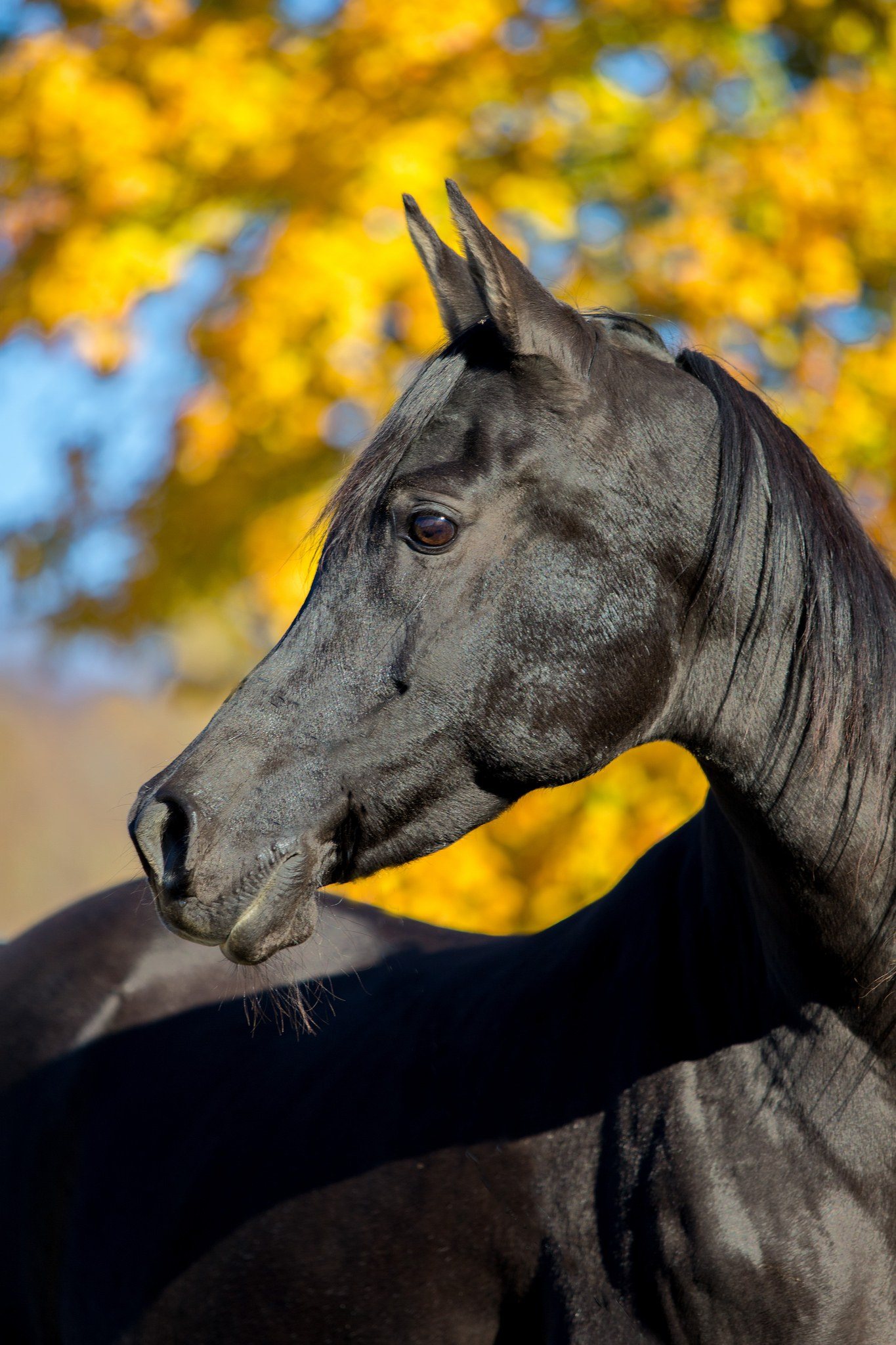
The Arabian is unmistakable: a dished (concave) face with wide-set eyes and small curved ears, a high-carried tail, and an arched neck flowing from a short, strong back — Arabians have one fewer vertebra than most breeds, which contributes to the compact look. Fine-boned but famously hardy, with dense bone and tough hooves.
Care & daily life
Arabians are easy keepers that thrive on routine: quality forage as the diet's base, measured concentrates only as work demands (they gain weight easily), daily turnout, and consistent handling. Their intelligence rewards fair, calm training — they remember both good and bad handling for years. Feet are typically hard and may go unshod for light work; endurance prospects need the full conditioning program of gradually increasing distance work.
Health & lifespan
The Arabian is generally known for the following health watch-points:
- Severe combined immunodeficiency (SCID) — a fatal foal condition; DNA testing has made it manageable in breeding
- Lavender foal syndrome, an inherited neurological condition (DNA-testable)
- Cerebellar abiotrophy, an inherited coordination disorder (DNA-testable)
- Guttural pouch conditions occur at higher rates than in many breeds
- Generally a hard breed overall — sound feet, dense bone, and low rates of many common lamenesses
Living with a Arabian
Arabians suit riders who want a thinking partner: endurance riders, trail riders, and show competitors, in climates from desert to cold (they are adaptable with shelter and, in winter, appropriate care). They are a 25–30-year commitment requiring daily care, turnout, and an engaged owner — a bored, stalled Arabian is an inventor of mischief.
History
The Arabian is the oldest documented pure breed, developed by the Bedouin tribes of the Arabian Peninsula over thousands of years, selected for survival in the desert: sparse forage, extreme heat, and war. Mares were prized above stallions and lived inside family tents. Through imports such as the Godolphin Arabian, the Darley Arabian, and the Byerley Turk — the three foundation sires of the Thoroughbred — Arabian blood flows in most modern light-horse breeds. Purebred registries were formalised in the early 1900s.