Overview
The Birman — the Sacred Cat of Burma — is the gentle soul of the longhaired world: a beautiful pointed cat with sapphire eyes and immaculate white gloves, wrapped around one of the sweetest temperaments of any breed. Birmans were made for companionship. They follow their people with soft voices and softer manners, join in without taking over, and bring a calm, almost serene presence to a household. If the Siamese is a conversation at full volume, the Birman is the same conversation held in a library voice.
Temperament & personality
Gentle, affectionate, and peaceable to the core. Birmans bond with the whole family rather than selecting one person, are notably tolerant of children and other animals, and greet visitors with calm curiosity. They are playful in a measured way — games are enjoyed, then a nap is taken — and they dislike long solitude. Owners prize the breed's balance: interactive and loving, never hyper, never aloof — the Birman seems engineered for harmonious multi-species households.
Appearance
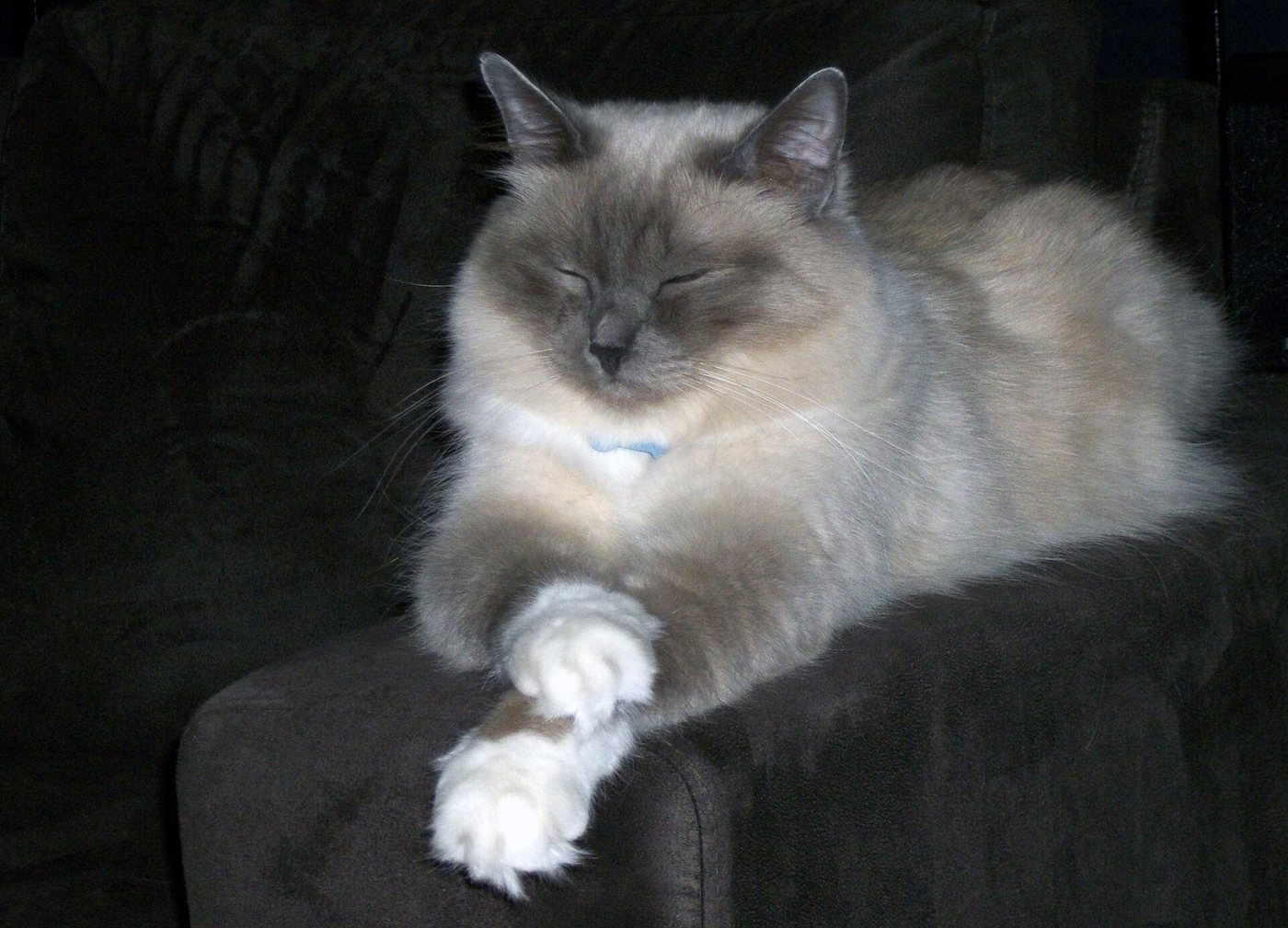
The Birman is a medium-to-large, well-built cat with a silky, medium-long coat that famously does not mat, a bushy tail, and pure white 'gloves' on all four paws — a defining requirement of the breed. The body colour is pale (cream to golden-toned) with darker points on the face, ears, legs, and tail in seal, blue, chocolate, lilac, and tabby or red-series variations. The eyes are a deep, almost hypnotic sapphire blue, and the head is broad and rounded with a medium-length Roman nose.
Care & daily life
The silky single-textured coat is unusually easy for a longhair: comb once or twice a week to remove loose hair and keep it flowing; it sheds seasonally but rarely mats. Birmans are moderately active — playful in sessions, calm between them — and appreciate cat trees, window perches, and daily interactive play without needing an athlete's regime. They are indoor cats by temperament and by value; a secure garden or enclosure is a bonus. Routine dental care and weight watching round things out.
Health & lifespan
The Birman is generally known for the following health watch-points:
- Hypertrophic cardiomyopathy (HCM) occurs; ultrasound screening is used in breeding programs
- A rare inherited condition causing very low blood potassium (hypokalemia) has been identified in Birmans and is DNA-testable
- Congenital hypotrichosis with thymic aplasia — an extremely rare immune condition reported in the breed, associated with hairless kittens; breeders are aware of it
- Feline infectious peritonitis (FIP) incidence has historically been noted in the breed — discuss cattery hygiene and health history with breeders
- Overall considered a sound, long-lived breed
Living with a Birman
Birmans suit almost any calm, affectionate household — families with children, seniors, multi-pet homes, and first-time pedigree owners all feature heavily among Birman devotees. They want involvement without intensity: present in the room, joining games, welcoming visitors, then settling quietly. They are indoor cats whose only real requirements are company, gentle play, and people who appreciate a serene, beautiful companion.
History
Legend says Birmans were temple cats in Burma, companions to Kittah priests, and that the breed's blue eyes and white gloves came from a goddess's touch — lovely, and unverifiable. Documented history begins in France in the early 1900s, where a pair of cats (tradition names them Orloff and Xenia) founded the European breed; the Birman was recognised in France in 1925. The Second World War nearly extinguished it — tradition holds that only one pair survived — and post-war breeders rebuilt it patiently, with outcrosses later bred back to type. It reached Britain and the United States in the 1960s and has been a beloved, gentle fixture ever since.