Overview
Take everything the Siamese is — the sleek wedge-headed body, the sapphire eyes, the genius-level social intelligence, and the most famous voice in the cat world — and widen the wardrobe. That is the Colorpoint Shorthair: a Siamese in red, cream, tortie, and tabby points, developed in the mid-twentieth century by breeders who wanted more colours on that perfect frame. CFA counts it a separate breed; most other registries simply call it a Siamese. Either way, it is a cat for people who want maximum personality per pound.
Temperament & personality
Affectionate, extroverted, and gloriously demanding. Colorpoints bond intensely, follow their people from room to room narrating as they go, and have opinions on feeding times, visitors, and the household schedule, all delivered at full volume. They are clever, sensitive to mood, and quick to learn games and routines. This is not a cat that fits quietly around your life; it expects a central role in it — and earns the role with real devotion.
Appearance
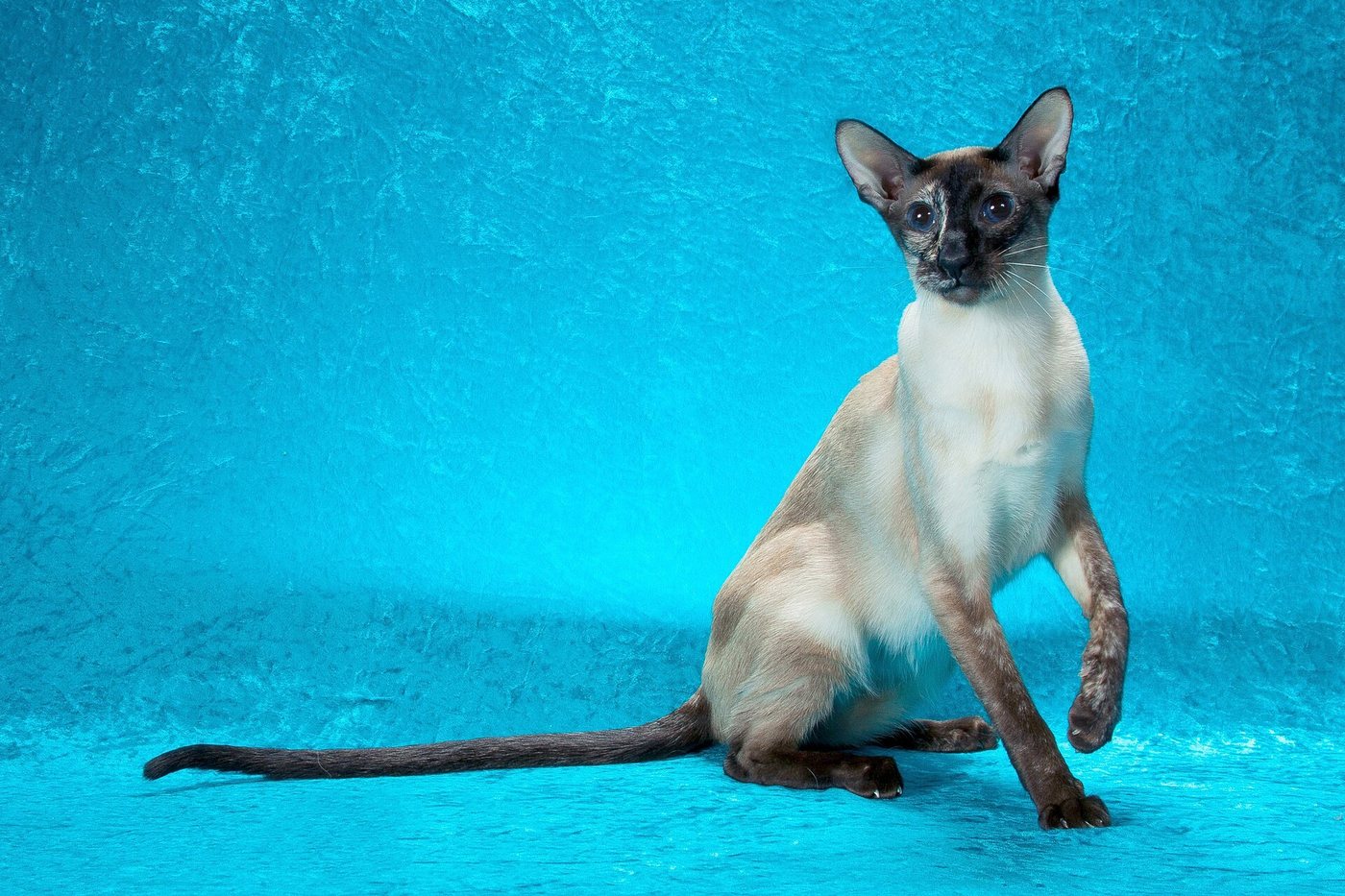
Identical in build to the Siamese: a long, tubular body on slender legs, a fine-boned wedge head with enormous ears, and almond eyes of deep sapphire blue. The coat is short, fine, and glossy, lying close to the body. The difference is purely the palette — where the Siamese is limited to four point colours, the Colorpoint offers sixteen or more combinations in CFA: red, cream, cinnamon, and fawn points, plus tortie (patched) and lynx (tabby) versions of each, all with the same pale body and shaded points.
Care & daily life
Coat care is negligible — an occasional comb-through and the cat does the rest. The real commitments are attention and dentistry: Colorpoints need abundant interaction, play, and preferably a feline companion, and the Siamese family is prone to dental disease, so tooth brushing and dental checks matter. Provide climbing height, warm spots, and a household that talks back. These are indoor cats whose fine coats offer no weather protection.
Health & lifespan
The Colorpoint Shorthair is generally known for the following health watch-points:
- Shares the Siamese family health profile in full
- Amyloidosis — a protein-deposition disease chiefly affecting the liver — is reported in some Siamese-family lines; ask whether it has appeared in the pedigree
- Feline asthma and bronchial disease occur more often in this family than in cats generally
- Progressive retinal atrophy (PRA) — a DNA test exists and responsible breeders screen
- Dental disease and gingivitis are common everyday problems in the breed family; start dental care in kittenhood
- Occasional congenital heart defects are reported; reputable breeders remove affected lines from breeding
Living with a Colorpoint Shorthair
Colorpoint Shorthairs are for interactive households: people who are home a good deal, or who keep two cats, and who actively enjoy a talkative, opinionated companion. They do well with other pets and sensible older children, and they are strictly indoor cats. They are a poor match for anyone wanting a quiet, self-sufficient pet — this breed wants in on everything, and says so. For the right home, though, they are among the most devoted and entertaining cats in existence.
History
In the 1940s and 1950s, breeders in England and the United States set out to do something Siamese purists considered heresy: give the Siamese new point colours. They crossed seal point Siamese with red tabby American Shorthairs — with Abyssinian in some lines — and worked back toward pure Siamese type while keeping the new red-series colours. After years of resistance, CFA recognised the result as a separate breed, the Colorpoint Shorthair, in 1974. Other registries took a different administrative view: TICA and most of the world register the very same cats within the Siamese breed group. The cats, indifferent to paperwork, have remained identically themselves throughout.