Overview
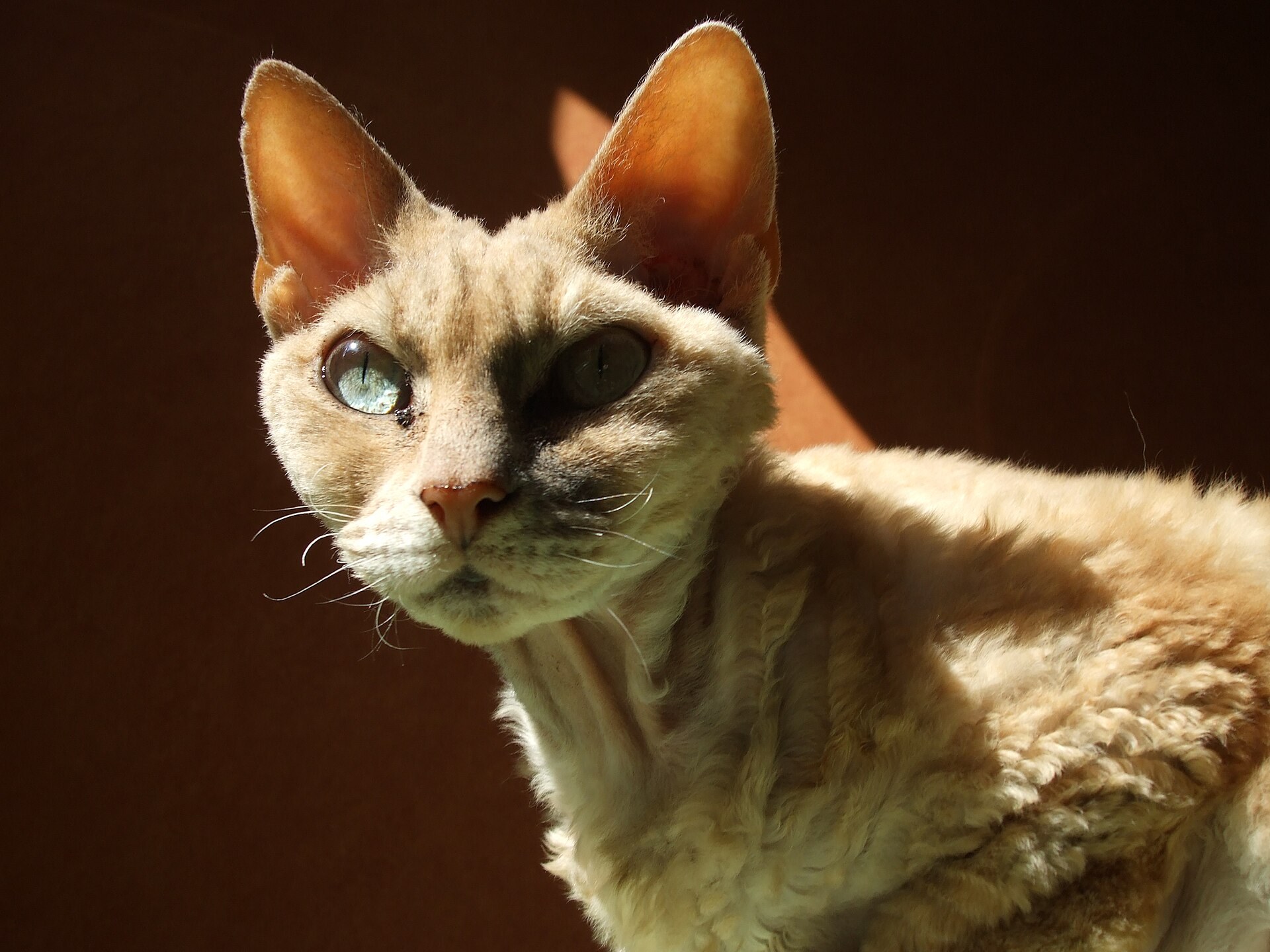
The Devon Rex is the cat world's impish pixie: huge ears, enormous eyes, a wavy suede coat, and a personality that owners describe as part cat, part dog, part monkey, part clown. Devons live to be involved — riding on shoulders, fetching toys, greeting guests, and inserting themselves into whatever is happening, preferably at face height. Beneath the comedy is a genuinely affectionate, intelligent breed that forms intense bonds with its people and never quite grows out of kittenhood.
Temperament & personality
Mischievous, devoted, and endlessly entertaining. A Devon Rex does not observe your life; it participates in it — supervising cooking from a shoulder, 'helping' with keyboards, and claiming the warmest spot in any room, which is usually you. They are highly social with children, other cats, and dogs, hate being left out, and combine acrobatic energy with a surprising fondness for simply being carried around. Quiet compared with many oriental breeds, they communicate in chirps and soft, pleased noises.
Appearance
The Devon Rex is instantly recognisable: a pixie-like cat with enormous low-set ears, huge oval eyes, high cheekbones, a short muzzle, and a slim body on long legs. The coat is the other signature — very short, soft, and wavy, with a rippled, suede-like texture and sparse coverage; some Devons have noticeably thinner hair on the chest and belly, which is normal for the breed. Whiskers and eyebrows are short, curly, and brittle. Colours and patterns cover the full range.
Care & daily life
The Devon Rex coat is low-maintenance but the ears and skin are not: the large ears accumulate wax and need gentle weekly cleaning, and the fine coat offers little barrier, so skin can turn oily — many Devons need an occasional bath, which most tolerate surprisingly well. Being sparsely coated, they feel the cold and seek heat constantly; provide warm beds and expect a permanent lap-and-under-blanket companion in winter. They are indoor cats — that coat gives almost no protection from sun or cold outdoors. Active and athletic, they need play, climbing shelves, and food puzzles.
Health & lifespan
The Devon Rex is generally known for the following health watch-points:
- Hypertrophic cardiomyopathy (HCM) — screening by ultrasound is recommended for breeding cats
- Devon Rex myopathy (hereditary myopathy, sometimes called 'spasticity') — an inherited muscle condition; breeding stock should be selected with this in mind
- Patellar luxation (slipping kneecaps) occurs in the breed
- Skin and coat realities: the sparse coat can wear thin or break, skin may be oily and need occasional bathing, and ears produce noticeable wax requiring regular cleaning
- Hypotrichosis — some lines carry genes for unusually sparse coats beyond the breed norm
Living with a Devon Rex
Devon Rexes suit people who want a shadow: they follow, climb onto shoulders, join showers, and regard closed doors as personal insults. They fit families, multi-pet homes, and apartment living beautifully, provided the home is warm and someone is around much of the day. They are strictly indoor cats because of their sparse coat. Owners should expect an agile, food-motivated little acrobat that will investigate every shelf, plate, and lap in the house.
History
The Devon Rex began in 1960 in Buckfastleigh, Devon, where a curly-coated feral tom lived near a tin mine. A local woman, Beryl Cox, noticed a kitten from that tom — Kirlee — had the same wavy coat, and Kirlee became the foundation of the breed. Early breeders initially crossed him with Cornish Rex cats, but the kittens came out straight-coated, proving the Devon gene was a different mutation entirely (the two rex breeds are unrelated despite the shared county-border names and similar looks). Kirlee's descendants, carefully outcrossed, founded a breed now recognised worldwide.