Overview
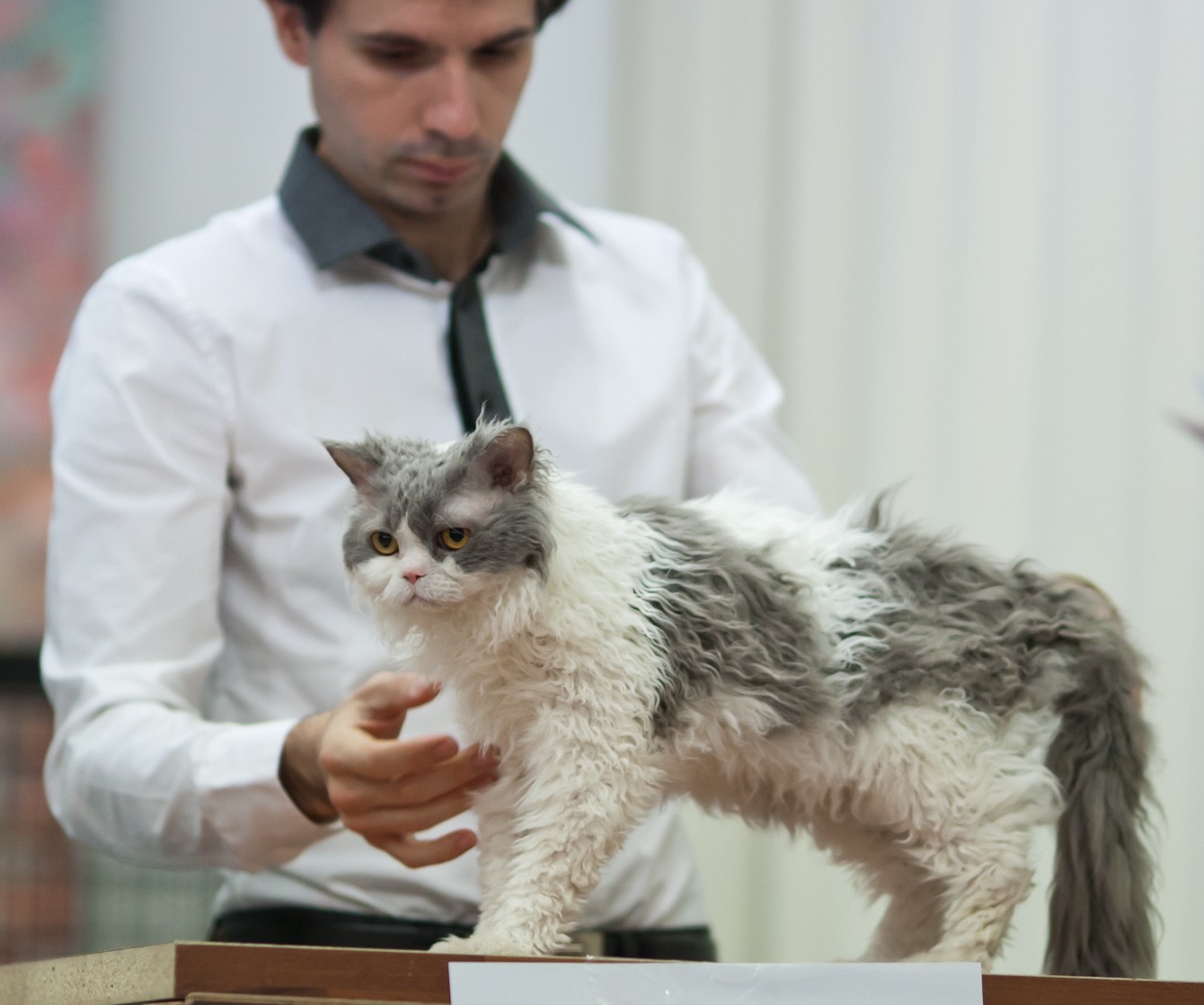
The Selkirk Rex is the cat in sheep's clothing: a big-boned, teddy-bear cat wearing loose, tousled curls that appeared by spontaneous mutation in a Montana shelter in 1987. Youngest of the Rex breeds, it pairs its novelty coat with one of the steadiest temperaments in the fancy — patient, cuddly, playful, and tolerant of nearly everything family life involves.
Temperament & personality
Easygoing, affectionate, and quietly funny. Selkirks combine the Persian's patience, the British Shorthair's reserve (in small measure), and the Exotic's cuddle drive into a cat that tolerates children, dogs, and dress-up with unusual grace. They play in a clownish, unhurried style, talk in a soft voice, and gravitate to laps and beds. If the other Rexes are pixies and athletes, the Selkirk is the big, huggable sheepdog of the group.
Appearance
The Selkirk Rex wears a disheveled, sheep-like coat of loose curls and ringlets — 'the cat in sheep's clothing' — over a substantial, well-muscled body with heavy bone. Both longhaired and shorthaired versions exist; the curl is softest and most tousled in the longhair. The head is round with a short muzzle, a proper nose stop, big round eyes, and curly whiskers that often break short. Curls vary by individual and even by season — some Selkirks are dramatically ringleted, others softly waved.
Care & daily life
Counterintuitively, curly coats need a light touch: comb gently once or twice a week with fingers or a wide comb, and never brush out the curl — over-grooming straightens and frizzes it. The coat sheds more than you'd expect for a Rex, and the greasy build-up some curly cats get means an occasional bath helps. Ears can accumulate extra wax and should be checked. Otherwise, standard care: weight watching (they're hearty eaters), dental checks, and routine vet visits.
Health & lifespan
The Selkirk Rex is generally known for the following health watch-points:
- Generally healthy, and the breed's outcross foundation gives it reasonable diversity
- Polycystic kidney disease (PKD) is screened for because Persian and Exotic blood founded the breed — ask for DNA results
- Hypertrophic cardiomyopathy (HCM) screening by ultrasound is recommended for breeding cats
- The curly coat can come with oilier skin and increased ear wax — occasional baths and ear checks help
- Hearty appetite and a solid build make weight management a routine concern
Living with a Selkirk Rex
Selkirk Rex cats fit almost any home — families with children, multi-pet households, singles, and apartments. They want moderate play, warm laps, and company without demanding constant entertainment. Their patience makes them a standout choice for busy families and therapy-cat work. Keep them indoors, keep the combing gentle, and expect a cat that looks like a stuffed toy and behaves like an old friend.
History
In 1987, a Montana animal shelter took in an unusual blue-cream kitten with a curly, plush coat and broken whiskers — the only curly kitten in her litter. Breeder Jeri Newman adopted her, named her Miss DePesto (after a curly-haired TV character), and bred her to a black Persian; half the kittens were curly, proving a new dominant Rex gene, different from the Cornish and Devon mutations. Newman named the breed Selkirk for her stepfather (and the Selkirk Mountains), and built it with Persian, Exotic Shorthair, American Shorthair, and British Shorthair outcrosses. TICA recognised the breed in 1994 and the CFA followed; it remains the youngest of the Rex breeds.