Overview
The Icelandic Horse is a living time capsule: descended from the horses Norse settlers shipped to Iceland over a thousand years ago, and kept absolutely pure ever since by the world's oldest horse law — no horse may enter Iceland, and any horse that leaves may never return. The result is a small, immensely hardy, double-coated riding horse with two extra gaits — the smooth tölt and the racing flying pace — a palette of forty-plus colours, and a lifespan that regularly humbles bigger breeds. In Iceland it is simply 'the horse': worker, racer, companion, and national treasure.
Temperament & personality
Icelandics are friendly, curious, and full of character — willing partners with a streak of cheerful independence bred by centuries of semi-feral herd life. They are famously sensible on treacherous ground, unspooky, and sociable with people, yet nobody's pushovers: they think. Riders love their combination of fire and reliability — a horse that will tölt joyfully all day across lava fields and then stand quietly for a child to brush.
Appearance
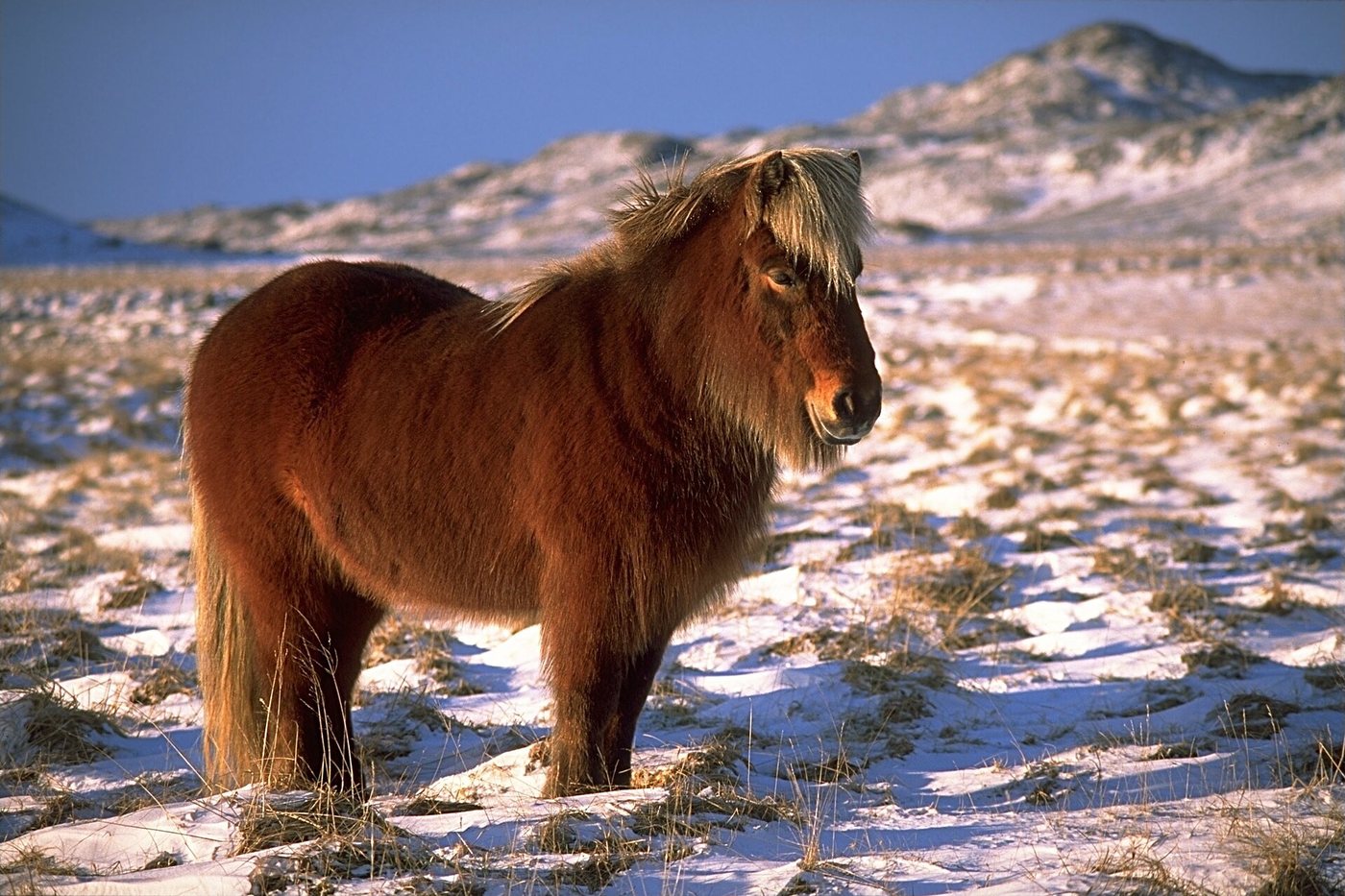
Small but unmistakably a horse in proportion: a sturdy, well-muscled body on short, strong legs, a handsome head with a kind, wide-set eye, and an extravagant double coat with a mane and forelock so thick it looks styled for winter — because it is. In winter the coat is a deep, woolly armour against arctic weather; in summer it sheds to a sleek shine. Colours run from black through dun, palomino, and silver dapple to pintos and roans, often with primitive eel-stripes and leg barring.
Care & daily life
Icelandics are thrifty, low-maintenance horses: forage feeding (they evolved on sparse grazing — rich pasture and grain are genuine dangers, inviting obesity and laminitis), shelter available but often ignored by choice, and company — they are herd animals. Feet are strong and many go barefoot. Two management notes dominate outside Iceland: exported horses need monitoring for sweet itch (an allergy to midge bites unknown in Iceland), and imported horses should be introduced to rich feed gradually, if at all.
Health & lifespan
The Icelandic Horse is generally known for the following health watch-points:
- Famously free of most equine diseases — Iceland's isolation and import ban mean the population has never met many common pathogens, and there is no dominant inherited disease in the breed
- Sweet itch (insect-bite hypersensitivity) is THE health issue of exported Icelandics: Culicoides midges do not exist in Iceland, so horses meet them for the first time abroad, and a substantial share of exported horses develop severe skin allergy. When buying outside Iceland, ask whether the horse is already proven in a midge climate
- Easy-keeper risk abroad: obesity and laminitis on lush foreign pasture — manage grazing strictly
- Spavin (hock arthritis) has been studied in the breed and occurs at moderate rates; soundness screening before purchase is standard practice in Iceland
- Otherwise iron-hardy: sound feet, strong bones, and extraordinary longevity are the breed norm
Living with a Icelandic Horse
Icelandic Horses suit riders who want adventure in a small, tough package: trekkers, gait enthusiasts, families, and riders in harsh climates where 'hardy' is a requirement, not a compliment. They are economical to keep — small appetites, strong feet, few vet bills — across a lifespan that can exceed three decades. Exported horses need midge management where sweet itch exists; otherwise, this is as close to a maintenance-free horse as the species offers.
History
Norse settlers brought horses of Scandinavian and British Isles stock to Iceland between about 874 and 930 AD. Around 930, the Althing — Iceland's parliament — banned further imports to protect the stock from disease and dilution, a law that stands today: Iceland's horses remain genetically the horses of the Viking Age. For a thousand years they were Iceland's only transport, plough, and pack animal, ridden across lava deserts and glacial rivers. Exported worldwide since the mid-20th century, they remain among the purest and oldest breeds in existence.