Overview
The Russian tortoise — Horsfield's tortoise to much of the world — is the small tortoise that built the modern hobby: a round, yellow-brown, four-toed digger from the Central Asian steppe, hardy enough to forgive weather that would kill a tropical species and bold enough to march up to its keeper demanding dandelions. It is also the tortoise most often bought on impulse and most often underestimated: it roams, digs like machinery, and can easily outlive its purchaser. One even went to space — Russian tortoises circled the Moon aboard Zond 5 in 1968.
Temperament & personality
Russians are scrappy extroverts. They learn feeding routines fast, come running (at tortoise speed) for favourite weeds, and spend their days patrolling, climbing, and excavating — a Russian at rest is usually a Russian planning something. Males can be persistent and nippy with other tortoises, and even females do best with generous space; groups need room and sight breaks. Their hardiness is real, but it should not be confused with low needs: boredom and cramped quarters produce frantic climbers and escapees.
Appearance
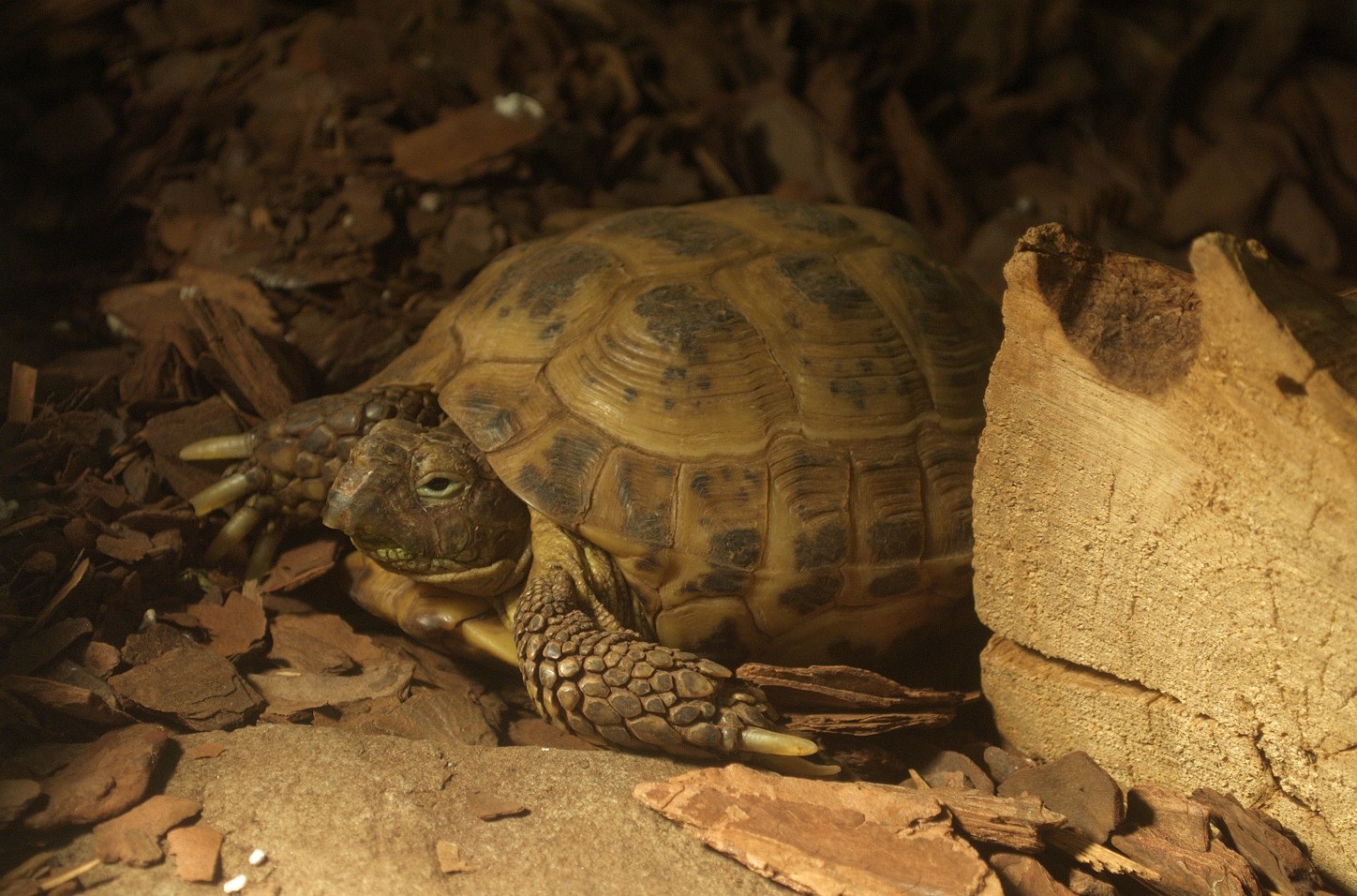
A compact, nearly circular tortoise with a domed carapace in shades of olive, tan, and yellow-brown, each scute often centred with dark pigment. The plastron carries bold black blotches. The giveaway identification: four toes on the front feet where most tortoises have five. Males are smaller, with longer tails and a more concave plastron; females are rounder and larger. The beak and claws are built for grazing coarse steppe plants and digging deep burrows.
Care & daily life
Space and substrate are the Russian tortoise story. Give an adult at least a 4×2 ft open-top tortoise table (more is better; an outdoor pen in the warm months is better still) with several inches of soil-based substrate it can dig into, a basking spot of 95–100°F under a lamp on a thermostat, a proper UVB tube, and a cool end in the 70s. Walls must be tall and corners capped — they climb astonishingly well and dig under fences. Feed the steppe diet: pesticide-free weeds and leafy greens (dandelion, plantain, sow thistle, endive, escarole), a little hay, almost no fruit, with calcium carbonate dusted on food. Provide a shallow water dish. Many keepers hibernate (brumate) healthy adults; it is natural for the species but should only be done with guidance and a healthy, vet-checked animal.
Health & lifespan
The Russian Tortoise is generally known for the following health watch-points:
- Respiratory infections — runny nose ('RNS') is a red flag, especially in recently imported animals
- Shell pyramiding and metabolic bone disease on protein-rich diets or without UVB
- Internal parasites — many pet Russians are wild-caught imports; a fecal check is essential
- Beak and nail overgrowth when food is too soft and surfaces too smooth
- Bladder stones from chronic dehydration and rich diets
Living with a Russian Tortoise
Russian tortoises suit keepers wanting a small, hardy, personable tortoise with the space for a table or outdoor pen and a horizon measured in decades — 30 to 50 years is a normal expectation, so this is a pet that may need a place in your will. They are excellent for temperate climates and for supervised outdoor keeping in summer. They are a poor choice for small glass tanks, for carpet-floor free-roaming, or for anyone whose 'small tortoise' plan assumes the animal stays the size it was in the shop.
History
Russian tortoises range across the arid steppes and rocky hillsides of Central Asia, where brutal summers and winters shaped an animal that aestivates in heat, hibernates in cold, and digs burrows metres long. Named for naturalist Thomas Horsfield, they were exported in enormous numbers through the 20th century — first from the Soviet Union, later from Central Asian farms and wild collection — and remain among the most traded tortoises in the world, with real pressure on wild populations. In 1968 two of them flew around the Moon on the Soviet Zond 5 probe and came home safely, history's first tortoise astronauts.