Overview
The Mongolian gerbil is the engineer's pet: a social desert rodent whose entire life revolves around the burrow. Unlike a hamster, a gerbil must have company of its own kind, produces almost no smell, and is active in sociable bursts through the day. Unlike most rodents, it should live in a deep-filled tank rather than a cage, because digging tunnels is not play for a gerbil — it is the main occupation.
Temperament & personality
Bright, inquisitive, and busy. Gerbils investigate everything, stand up to survey their surroundings, and work in shifts on the tunnel network. They are gentle with people, rarely bite, and tame into coming to the glass for treats — though they generally prefer exploring your hands to being held still in them. Bonded pairs are affectionate, sleeping curled together.
Appearance
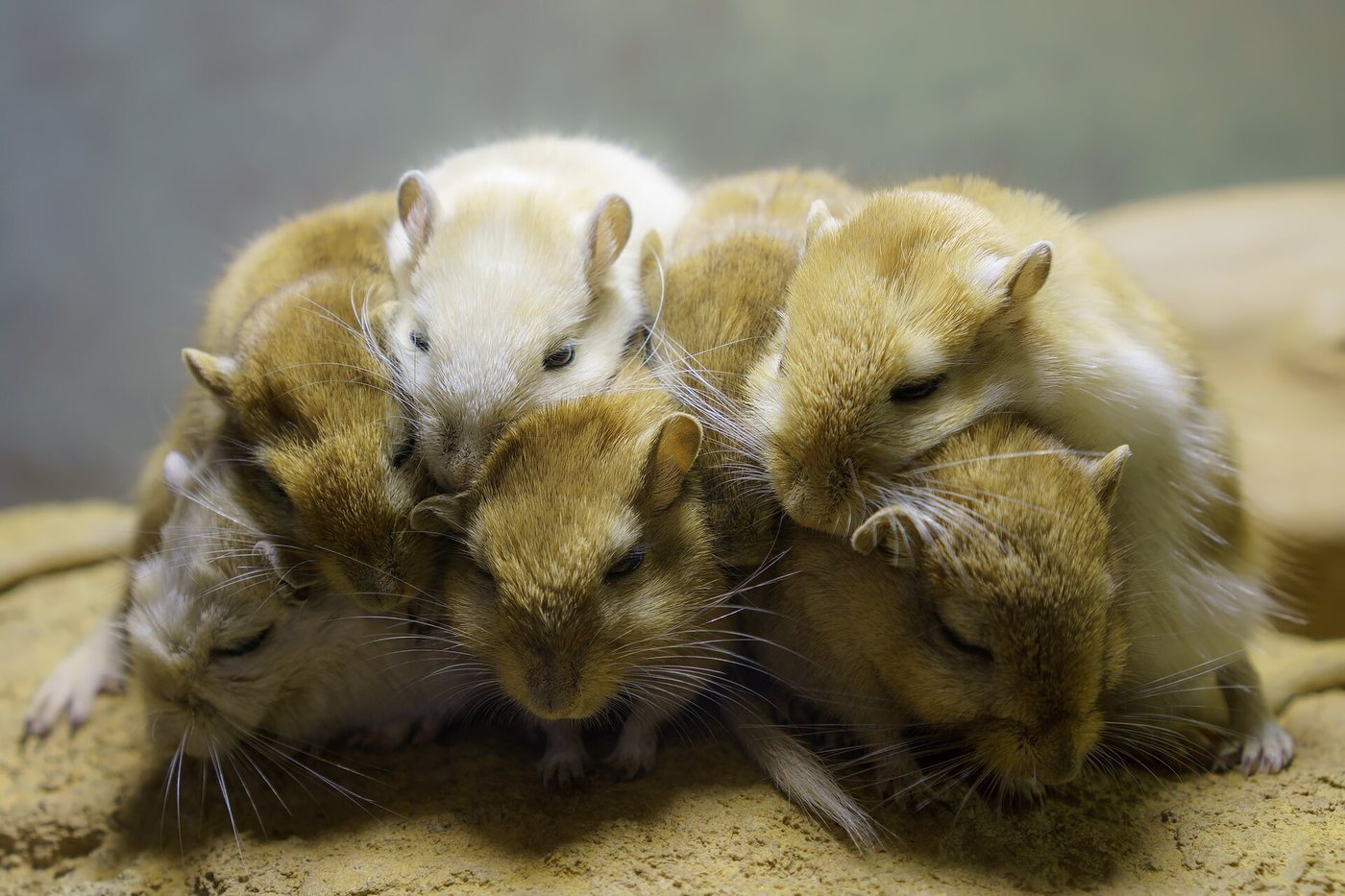
A desert rodent built like a miniature kangaroo-cross: long hind legs, big dark eyes, large ears, and a very long tail ending in a dark tuft, used as a balancing prop. The coat is soft agouti gold-brown above and cream below, designed to disappear against sand. Adults are dainty but strongly built, with teeth and claws made for digging through compacted steppe soil.
Care & daily life
Keep in a glass tank (gerbilarium) filled with at least 25 cm (10 inches) of bedding mixed with hay so tunnels hold their shape — digging is their core behaviour, not an enrichment extra. Feed a gerbil seed mix or pellets with hay and small amounts of vegetables; scatter-feed to encourage foraging. Avoid wire wheels with gaps (tails get caught) — use a solid wheel of 28 cm or more, or none if the tank allows long runs. Never grab by the tail: the skin can strip off (degloving). Introduce new gerbils only with the split-cage method over days.
Health & lifespan
The Mongolian Gerbil is generally known for the following health watch-points:
- Epileptic-type seizures triggered by stress or new environments in some lines — usually outgrown and rarely treated
- Scent-gland tumours in older males (a lump on the belly) — often removable if caught early
- Tyzzer's disease, a serious bacterial illness of young or stressed gerbils
- Nasal dermatitis ('sore nose') from digging against bars or allergy to bedding resins
- Tail degloving if grabbed by the tail — a preventable handling injury
Living with a Mongolian Gerbil
Gerbils suit people who like watching animal engineering: give a pair deep bedding and by morning there is architecture. Their low odour and daytime activity make them good pets for older children and for homes where a hamster's night routine doesn't fit. They need a glass tank rather than a barred cage (bars get chewed and noses get sore), and their clan loyalty comes with a rule — adults that fall out ('declanning') must be separated for good.
History
Mongolian gerbils were collected by the missionary-naturalist Père Armand David in the 1860s and described scientifically as Meriones unguiculatus — the 'little clawed warrior'. A small number imported to Japan and then the US in 1954 founded most of the pet and laboratory population. In the wild they live in family clans defending complex burrow systems on the Mongolian steppe, which explains both their social needs and their obsession with digging.